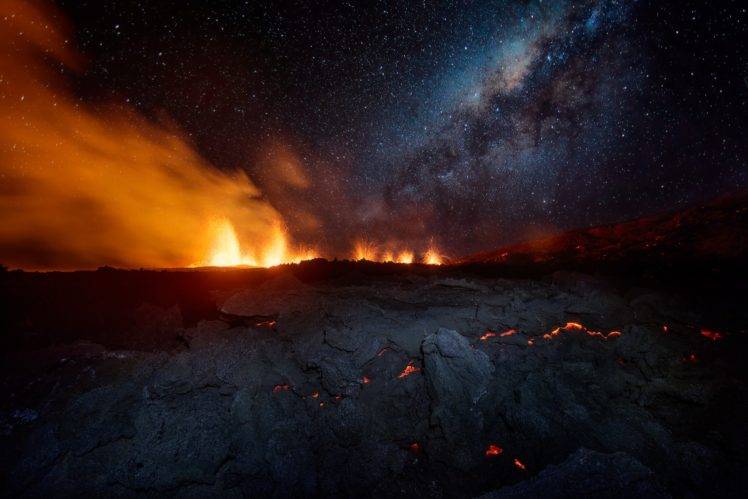
The story “Nightfall” written by Isaac Asimov is set on a planet known as Lagash. One of the most extreme differences between Lagash and Earth is that Lagash has six suns. The result of being a six-sun planet is that Lagash does not know darkness, as the plant is covered by constant sunlight. Supposedly a group of scientists have discovered that there is a cycle that occurs every 2000 years. An eclipse occurs, followed by complete darkness, which allows stars to be seen. Naturally, the civilians of Lagash have never seen the stars due to their six suns; it has not been dark enough to see the stars in 2000 years. The scientists who discovered the cycle believe that when the darkness comes, everyone will go mad.
My main focus is not in what will happen when the stars appear, but the reason behind the cycle. The scientists believe that the reason behind the cycle is what they refer to as the Theory of Universal Gravitation. They believe that the rotation of the suns and the planets results in all of the suns being blocked once every 2000 years, causing the darkness. Because the people of Lagash have never been in complete darkness, they will begin to panic, setting fires in order to create light, thus burning the civilizations that they have built, or so say the scientists. The Cultists believe that once every 2000 years Lagash enters a cave, which is the cause of the darkness. Then the Stars appear, robbing the souls of men, leaving them to destroy the world they know.
Who is correct? Before answering that question, I’d like to first examine the conversation that takes place between Sheerin (a psychologist) and Theremon (a reporter). Sheerin explains that naturally there are people who survive the cycle, as someone had to write the Book of Revelations. He claims that children under the age of six or retarded people will not be driven to madness from fear because they do not understand. Drunks who are passed out during the event will not go mad. He completely discredits the Book of Revelations by stating that “Naturally, the book was based, in the first place, on the testimony of those least qualified to serve as historians; that is, children and morons,” (Asimov 19). However, perhaps the word of Sheerin is not completely viable, as he is biased towards the scientists argument, being a psychologist himself. Further inspection of both theories is required.
The scientists theory is much more plausible, as we experience eclipses on Earth and know that it is possible. However, people of Earth do not go mad as they experience darkness every day. People of Lagash will go mad because they have never experienced the ‘disappearance’ of the sun; they will believe the world is ending and lose their minds. This is a reasonable explanation. Taking a look at the Cultists theory, inaccuracy is evident from the very beginning. First, it is impossible that a planet could enter a cave, which is their explanation of the darkness. They also claim that the Stars rob the souls out of people, causing them to go mad. While there is no proof against the belief that stars are soul suckers, it is unlikely as stars are merely other suns that are extremely far away; however; the people who wrote the Book of Revelations would not have known this important detail.
Neither the religious nor the scientific side can be proven as it is a fictional story that does not state outright which theory is correct. However, based on the evidence submitted, it is safe to say that the Cultists’ theory is a bit outlandish and difficult to give credence to.
 Kayla's Sci-Fi Blog
Very thoughtful analysis of Nightfall. I generally agree that, while the story presents various interpretations of the events, there is a sense that the scientific explanation is the most legitimate. My own interpretation (as I said in class) was that Asimov was less concerned with proving one or another argument correct but simply with presenting the way humanity interprets things through various metaphysical lenses (religion, science, psychology, etc.) and comes to different conclusions. But I think you make a convincing argument that the Cultist version is not very plausible (planets in caves, etc.)
LikeLike